
Figure Ground
1-5 of 30
<-- prev || next -->
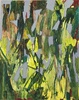
This is a fundamental concept in painting. It addresses the question of perception. How does the viewer see a two-dimensional surface? Color, shape, scale, density, and placement are among the ways a painting reveals its making. Since 2009, this concept has dominated my painting practice, not always successfully. But it is the visual game that led me to a spatial concept that felt adequate to match the shaky ground of this new century we live in.
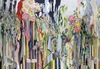 The Garden of Eve(2019—2025) |
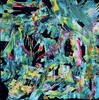 Glass Flowers(2023—2024) |
 |
 |
 |
Fragmentation
1-5 of 19
<-- prev || next -->
The concept of fragmentation entertains to the notion of parts to the whole. If a puzzle arrives in pieces in a box it will take some figuring to assemble the picture in its totality. It's possible that connecting the parts is about how we form our sense of wholeness or completeness rather than recreating someone else's fiction. The landscape paintings made during graduate school in the late 70s are a glimpse into this idea. This concept runs across several bodies of work but lands in consciousness in 2006 with the large painting Yellow Brick Road and the subsequent Remnant paintings.
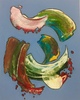 Big wind coming! (2020) |
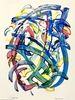 Broken Egg(2020) |
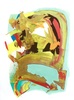 Carnival (2020) |
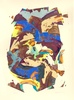 Chattoog(2020) |
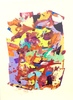 Fluttering (2020) |
The Garden
1-1 of 1
After visiting Buchart Gardens in Victoria, I returned home with a bounty of photographs of flowers. I was struck by my ability to fall into the beauty of that particular place. I fully understood the seduction of beautiful gardens and the solace they offered to visitors. I resisted the beautiful as an abstract painter, looking instead for a way to open the viewer's assumptions about how a painting might serve to expand one's being. My paintings resisted beauty as an intentional experience. I preferred to engage the viewer in curiosity, even resistance. But the experience in Victoria suggested there was something to consider about the heartfelt experience of beauty. So I committed to a project that would bring my preference for disorder up against the subject of beauty in a large-scale abstract composition. On this scale, a painting is in a conversation with the artist. It is a slow process because I was breaking my own assumptions about what a painting could be. There were times when the two panels were removed and placed in storage for a few weeks at a time. There were long stretches when we could only look at each other remorsefully, wishing to be done with the process. I threatened to paint over the painting. After six years of being in a relationship with this painting, I asked ChatGPT if the painting was finished. The response astonished me with favorable observations and what might be called insight into the intentions that I had struggled with over time. The final decision about completion was left to me. In November 2025, I finally called the painting by name, The Garden of Eve, and declared it finished.
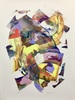 Carousel (2020) |
Pandemonium
1-5 of 9
<-- prev || next -->
Works completed during the COVID-19 pandemic or related to the pandemic beginning in 2020. The term expresses the world's state of mind, and in particular, the convergence of the pandemic, the death of George Floyd, and the subsequent civil unrest and government failures. Titles of works in this collection often reflect irony directed at the viewer's perceptions or states of being under duress.
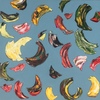 It's not that(2020) |
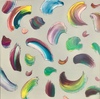 It's nothing! (2020) |
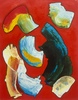 You are in deep water! (2020) |
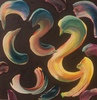 Yup! No sleep. (2020) |
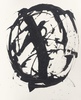 Breakthrough(2019) |
Writing as Drawing
1-5 of 25
<-- prev || next -->
How did we as human beings move from scratching marks in the sand to form images? I am interested in the space between these two conditions. I am particularly interested in the meaningless mark before it becomes encoded. I am interested in the possibility of the de codification of everything. This is one of the subterranean making activities I practice. It's being in a place that escapes language however temporarily. The practice contributes to thinking through abstraction as painting. Henri Michaud's drawings best embody this idea. I play with writing indecipherable texts. We have such a longing to make them mean something. But it offers so much more possibility in its inaccessibility. At that place, we are in the still moment before creation.
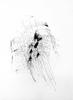 Enmeshed(2017) |
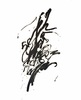 Running(2017) |
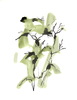 Leafed(2016) |
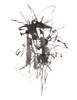 Nest(2016) |
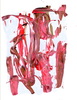 Red Bird(2016) |
The Fourth Wall
1-5 of 5
Abstraction as a means to challenge the viewer's perceptual experiences about what they are seeing.
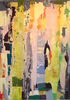 The Arrival(2016) |
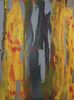 The Axe Falls(2016) |
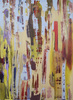 The Departure(2016) |
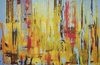 The Garden(2016) |
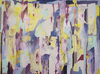 The Nursery(2016) |
Landscape
1-5 of 80
<-- prev || next -->
Landscape as a subject not just a background in painting has a long history in the Western world beginning in the early 16th century and persisting to now. Nature as subject became interesting to me growing up on eastern Long Island where woods and water were not far from my parents doorstep. I never tired of riding my bike to the Bayard Cutting Arboretum, or the Camp Eddie where I could row myself into the middle of the lake and watch the clouds float overhead. Once I had my own car I could drive out further east to Montauk Point or Orient Point and walk on the beaches or hang out at the harbor painting the sailboats or capturing still life of driftwood and dead matter. Even during my first semester at Buffalo State I made a large scale monochrome drawing of an alleyway with trash cans. The forlorn was a match for my young adult moodiness. In the process of earning my MFA at the University of South Florida in the mid-70s, I struggled with approaches to the landscape that shifted restlessly from fragmented impressions of the surrounding orange groves or fully abstracted horizontal drawings. I didn't have the history or the language to talk about this dual yearning until I was free of the influences of academia. Discovering Kandinsky's Concerning the Spiritual in Art opened up the conversation about abstraction. The paintings that followed borrowed linear structure from Kandinsky while applying color randomly but allowed inference to subject. Eventually fruther influenced by a residency with Miriam Shapiro at Blossom School of Painting at Kent State I was able to bring texture into the work as well. (See paintings from 1982
 To Beijing(2005) |
 |
 Shifting Ground(1992) |
 Songlines (Red)(1992) |
 Songlines Blue(1992) |
Poetry of Falling
1-2 of 2
The actual or implied horizon line in a landscape anchors the viewer to the ground and as such is comforting. All things are in place. The landscape paintings I did about the Everglades were static in that grounding. That single element allowed a response to painting to be about memory. I wanted less of that and more about the speculation of where the viewer stands. I removed the horizon from my paintings and started working vertically on gessoed paper. The absence of a horizon allowed gravity to be the impeller in the painting. Everything was structured downward in a descending cascade of marks. Color and marks worked together to suggest light without form.
 Tarquinia(2000) |
 Suspension(1997) |
Sign Language
1-5 of 17
<-- prev || next -->
Making marks has been an obsession of mine. It is the very thing that enables us to see ourselves from the outside. It awakens our consciousness of being and engenders agency. A mark is the first step toward language and the codification of sound; the beginning of image-text duality. Much of my artwork originates from this impulse to be in the space between image and text. But before the text is an image. When the image is replicated in association with meaning, it becomes a sign. The sign gains power when many eyes know its meaning. A stop sign is an almost universal example. My portfolio holds many works exploring the dynamics of the mark-to-image. In paintings like Argent Vif 1998, marks made with a black paint stick cover the pale yellow ground, relenting around an illusively intangible form, enabling an image without substance to emerge. Making art is about making the intangible, tangible, yet held in mystery. Looking at images in this Sign Language portfolio will take you through a wide-ranging material exploration of the philosophical chicken and egg question.
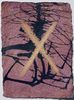 Nada(1999) |
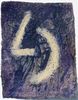 Question(1999) |
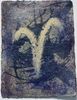 Ram II(1999) |
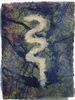 Staff(1999) |
 Staple(1999) |
Figurative
1-5 of 15
<-- prev || next -->
 |
 Hurricane Dancers 3,4(1993) |
 Hurricane Dancers 1, 2(1993) |
 Hurricane Dancers 5,6(1993) |
 Transit(1993) |
Angels
1-5 of 14
<-- prev || next -->
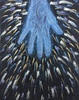
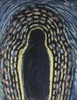
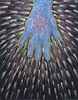
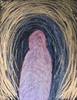
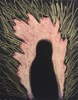
In 1984, I was living in a warehouse studio on a dead-end street in Sarasota. I felt insecure being the only person who went to sleep at night in that industrial area. I did some research on Haitian Voodoo and imagined envisioning angels protecting me in the studio space and wherever I went. Eschewing corporeal figures, I opted for feathery lines made with iridescent paint sticks and placed them in architectural settings borrowed from the Early Renaissance. Raised in the Catholic church, it was an easy steal. I took pleasure in blending Haitian spirits with Catholic architecture.
 |
 |
 |
 VTE(1988) |
 VTE/ Gros Bon Ange(1988) |
Installation Performance Collaboration
1-2 of 2
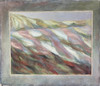
Starting in undergraduate school at Florida International University around 1974-75, I took a course that explored the role of myth as a form of storytelling across different cultures. A discussion of the loss of myth in Western metaphysics prompted speculation about the role of art in the rejuvenation of myth at this historical moment. Or something like that! I was also being influenced by Mark Lynch, a Miami artist whose sculpture practice was confrontational. My first off-the-easel project was conceived as a photographic documentation titled Animate Myth. I designed a painting 4' x 25' on muslin, covered in wide stripes that changed direction and color the length of the fabric. The painting reflected the codification of contemporary life as materialistic, embracing an economic engine that denied nature as a presence to be considered over growth and gain, setting up the dichotomy of culture vs nature. The painting was activated in natural spaces around the city, and with drama students in a performance in the Student Union in 1974. A slideshow of 200 images was staged in a hallway at the Miami Art Center during an invitational exhibition.
 Sea Sail(1975) |
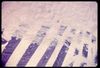 Animate Myth(1974) |
Vernacular
1-5 of 16
<-- prev || next -->
The New Oxford American Dictionary describes the noun vernacular as being the language or dialect spoken by ordinary people in a particular country or region. I use the term when talking about my paintings that apply a simple visual language and structure to address an issue of concern. Many of my drawings are conceived in a vernacular language. Paintings like the Madonna in Red, 1988, and the landscapes from the early 70's are conceived in ordinary visual language.
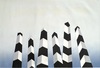 Aspire(1973) |
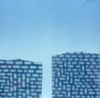 Capricorn's Gate(1973) |
 For Information Dial 411(1973) |
 Goodbye Sky(1973) |
 Long Time Gone(1973) |